Before
- For every load, someone opens the rate confirmation, the BOL/POD scan and the carrier's invoice side by side and checks each number by eye.
- Detention hours, lumper receipts and layover approvals get worked out by hand from in/out times and email threads.
- The customer invoice and the carrier bill are keyed into QuickBooks one line at a time, and disputes are written from scratch.
After
- The three documents are lined up in one match table: references, carrier, dates, weight, linehaul, fuel, detention, lumper, layover, totals.
- Anything missing or unreadable is marked needs a look. Your team makes every call; nothing is paid, billed or deducted on its own.
- Approved lines come out as a QuickBooks import CSV, and a draft email to the carrier or shipper lists exactly what's off.
Load packet (text as it comes off the PDF or email; pick a sample, edit it, or paste your own)
Sample loads:
Customer side of the load (from the TMS export): customer rate and accessorial terms
This page reads text only. In a pilot, scanned PDFs and photos are read first, and any field that can't be read with confidence is shown as "needs a look" instead of being guessed.
Pick a sample load or paste the three documents.
Match table
Every row shows its source values, so anyone can check the check.Customer invoice lines
QuickBooks import CSVA person reviews before import.
Carrier bill lines
QuickBooks import CSVOnly amounts the paperwork supports.
Draft email about the mismatches
Draft · not sentSubject:
Edit freely. In a real build it opens as a draft in your own mailbox; nothing goes out on its own.
Under the hood: fields read from each document (JSON)
How the check works
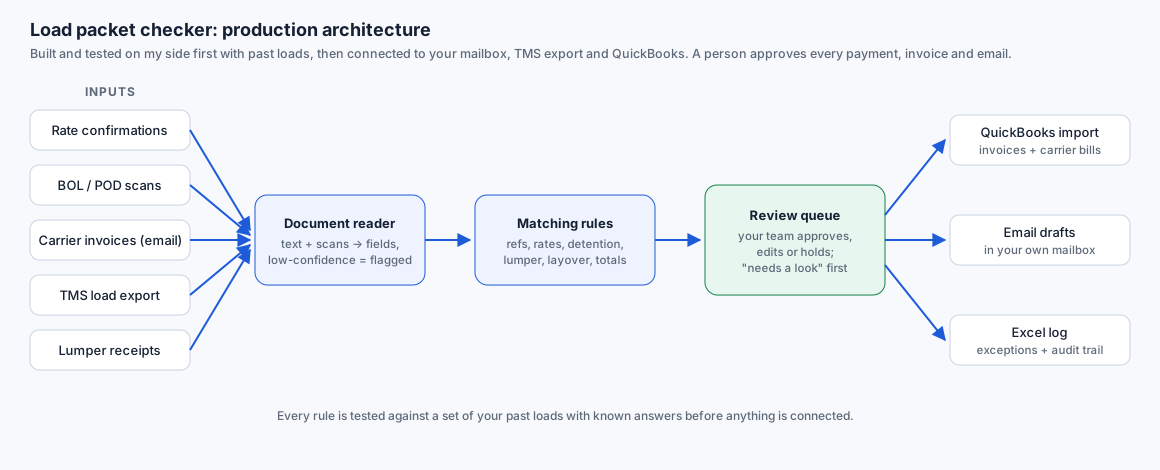
- Read. Each document becomes structured fields: load, BOL and PO numbers, carrier and MC, dates and in/out times, weight, and every charge line. This page uses a deterministic label parser; a production build adds document reading for scans and is held to the same field list, with this parser kept as a test check.
- Match. References must agree across all three documents (transposed digits are called out). Linehaul and fuel must equal the rate con. Detention is recalculated from the POD in/out times, the appointment and the free time on the rate con (15-minute steps, rounded down). Lumper needs a receipt. Layover needs a written approval.
- Hold, don't guess. Unreadable times, a missing signature, an exception on the POD or a charge with no backup are marked needs a look and held out of the export. A person decides.
- Prepare. Supported lines become QuickBooks Online invoice and bill import rows (column names are mapped to your own import file in a pilot), and the email draft lists only the specific items that are off.
Production architecture